Panama's Tax Code: Seven Decades of Accumulated Reforms
How a single tax law has been modified, supplemented, and partially overturned by dozens of subsequent laws across nearly seventy years — and what that means for taxpayers and the State.
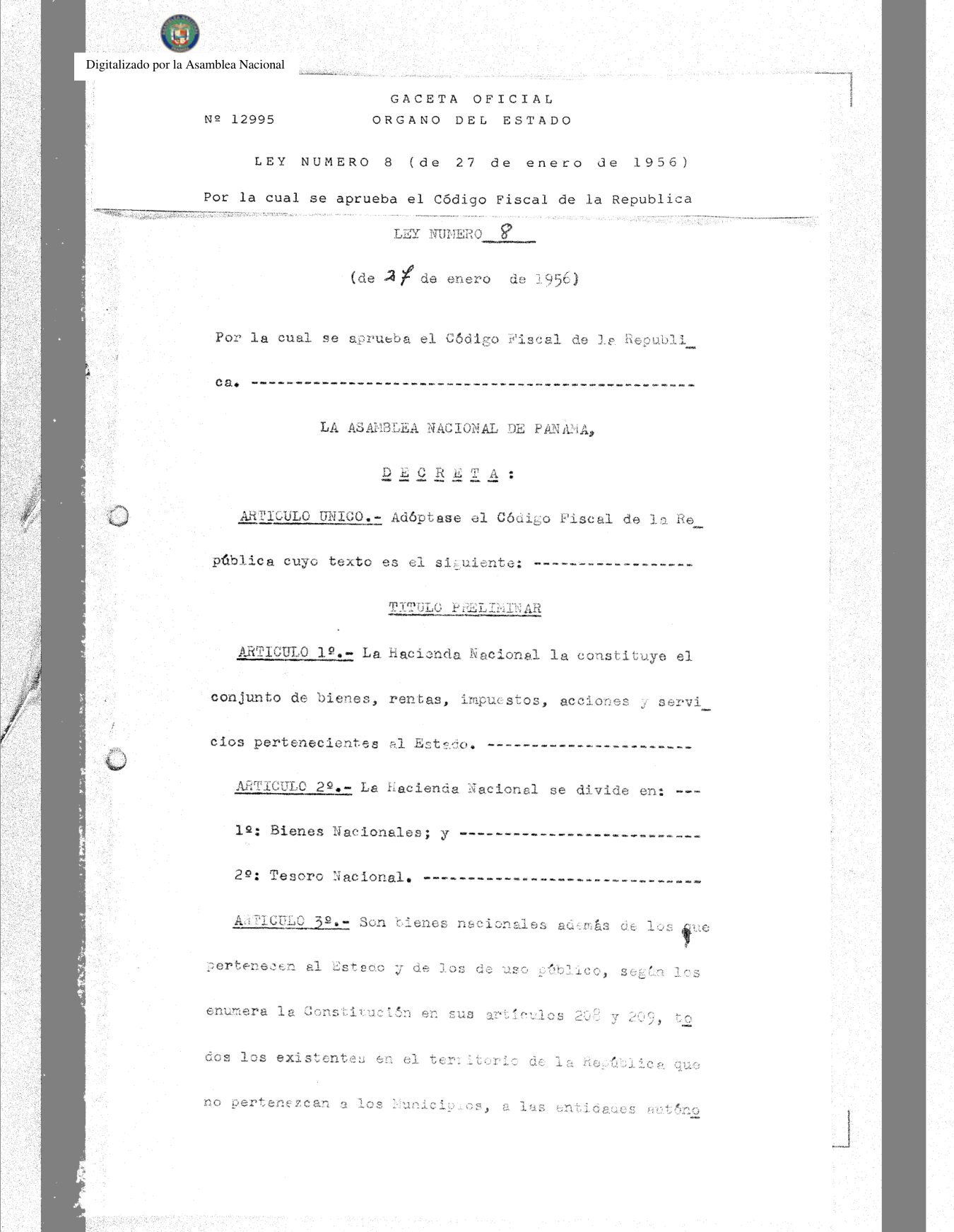
Panama's Tax Code was born on January 27, 1956, enacted as Law 8 of that year by the National Assembly. Since then it has not been replaced as the central tax statute; instead, it has been reformed again and again. Each subsequent law that touched the Code left a precise legal mark — it modified, repealed, or added articles to the existing text — making it possible to reconstruct who did what, when, and to which provision. What emerges is not a straight line of successive versions but a branching history in which a single statute can be modified, supplemented, and partially repealed by different laws almost simultaneously.
The most active point in that history is Law 8 of March 15, 2010 — distinct from the founding law of 1956 despite sharing the same number — enacted by the National Assembly under the title 'Reforming the Tax Code, Adopting Fiscal Measures, and Creating the Tax Administrative Tribunal.' Published in Official Gazette No. 26489-A and in force from July 1, 2010, this law is exceptionally active in the legislative record: it simultaneously modified and added articles to statutes from previous decades while itself receiving several subsequent modifications and a partial ruling of unconstitutionality.
The speed at which Law 8 of 2010 was revisited illustrates the dynamism — and at times the improvisation — of the tax legislative process. Just three and a half months after enactment, on June 30, 2010, the National Assembly passed Law 33 of 2010 ('Adding a Chapter to the Tax Code on Rules for Adapting to Treaties or Agreements to Avoid International Double Taxation, and Adopting Other Fiscal Measures'). That law modified Law 8 of 2010: the legislature had to return to the reform it had just passed to incorporate obligations arising from the double-taxation conventions Panama was signing. Two months later, on August 23 of the same year, Law 40 of 2010 ('Governing the Universal Scholarship Program and Modifying an Article of Law 8 of 2010 Relating to the Program's Financing') modified it again, this time to assign an educational funding source within the tax code itself.
This pattern repeated in the years that followed. In 2017, Law 13 of March 22 modified the specific article in Law 8 of 2010 relating to the Universal Scholarship. In 2020, Law 148 of April 21, which created the Universal Educational Social Assistance Program, again reformed Law 8 of 2010 — and that same Law 148 was in turn reformed by Law 385 of 2023, completing a three-link chain: Law 8 of 2010, reformed by Law 148 of 2020, reformed in turn by Law 385 of 2023. Each link carries its own effective dates, meaning that to determine the current text of any given article, a legal practitioner must trace the entire chain.
The most dramatic episode in the recent history of Law 8 of 2010 was authored not by the National Assembly but by the Supreme Court of Justice. On June 17, 2015, the Court issued a ruling declaring one of the law's provisions unconstitutional, removing it from the legal order. Shortly before that, on September 28, 2010, the National Assembly itself had published an Errata Notice to correct errors in the original text. Reform, textual correction, multiple subsequent modifications, and a partial declaration of unconstitutionality: that is the full profile of a tax statute over just fifteen years.
Looking backward from Law 8 of 2010 reveals the same density. In reforming the 1956 Tax Code, Law 8 of 2010 also modified earlier tax statutes from previous decades and repealed others, while affecting decrees that had reorganized the General Directorate of Revenue and other State entities. All of these legal effects form part of a legislative history stretching across several decades — one that cannot be read in any single document.
The value of tracing a statute's reform history with precision lies in making that accumulated complexity visible. When a law like the 2010 statute accumulates multiple modifications across different years — modifications to the text, additions of new articles, repeal of provisions, correction of errors, and a partial declaration of unconstitutionality — the result is that no citizen, lawyer, or official can know the current state of the Tax Code by consulting a single document. Understanding Panama's current tax law requires following that chain of reforms, statute by statute, from the origin to today.
Sources
- Ley 8 de 2010 — Reforma del Código Fiscal y creación del Tribunal Administrativo Tributario
- Ley 33 de 2010 — Adición de capítulo sobre doble tributación internacional y otras medidas fiscales